From First Lick to Last Bite: How to Taste Gelato Like You Actually Know What You're Doing
Most of us approach a scoop of gelato the same way we approach a great song on shuffle — we just enjoy it without thinking too hard about what makes it work. And honestly? That's totally valid. But here's the thing: when you slow down and actually taste what's in front of you, gelato reveals a depth of craftsmanship that rivals anything you'd find in a Michelin-starred kitchen.
Sommeliers spend years learning to decode a glass of wine. Specialty coffee roasters obsess over origin notes and brew ratios. Gelato deserves the same reverence — and developing the vocabulary and awareness to appreciate it isn't nearly as intimidating as it sounds. So let's break it down.
Start Before You Even Take a Bite
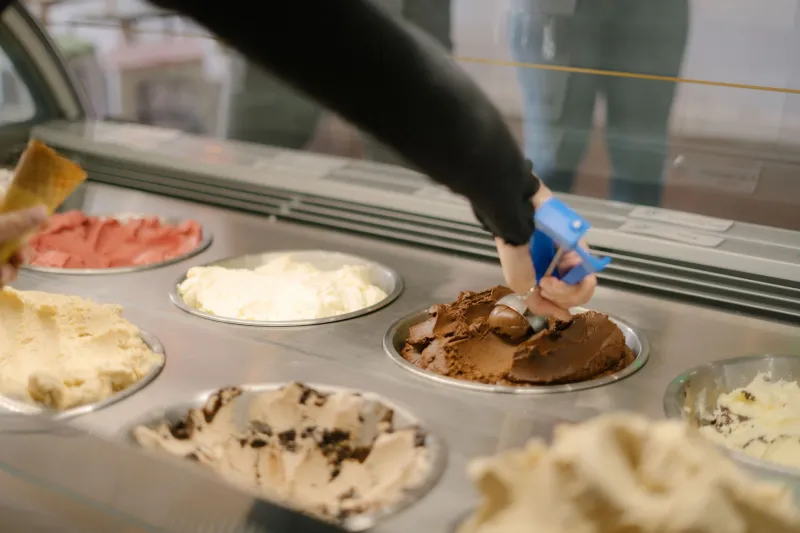
Serious tasting begins with your eyes. Before that spoon touches your lips, look at the gelato. Good artisan gelato should have a matte, almost velvety finish — not a glossy, plastic-looking sheen. That shine you often see on commercial frozen desserts? That's usually a sign of excess fat or stabilizers doing the heavy lifting.
Color matters too. A pistachio gelato made from real Sicilian pistachios will lean toward a muted, earthy green — not the neon shade that screams artificial flavoring. A fresh strawberry flavor should look like the inside of a ripe berry, not a cartoon. Natural hues are quieter and more complex, and they're your first clue that something worth tasting is waiting for you.
Then there's the texture at rest. Properly stored gelato sits dense and slightly soft in its pan — it doesn't stand up in stiff peaks or collapse into a puddle. That in-between consistency is a sign of balanced overrun (the amount of air churned into the base), which is a hallmark of authentic Italian-style gelato.
The Temperature Sweet Spot
Here's something most people don't know: temperature dramatically affects flavor perception. Gelato is traditionally served between 10°F and 22°F (-12°C to -6°C) — noticeably warmer than American-style ice cream, which typically hovers around 0°F. That warmer serving temperature isn't just a stylistic choice. It's functional.
When gelato is too cold, volatile aromatic compounds — the molecules responsible for flavor — are suppressed. Your taste buds simply can't register them. But as gelato warms slightly in your mouth, those compounds are released, and the flavor blooms. This is why a great scoop of hazelnut or dark chocolate gelato seems to deepen as you eat it, rather than delivering one flat note and calling it a day.
If you're ever served gelato that tastes muted or one-dimensional, temperature is often the culprit. Give it thirty seconds on your tongue before you make up your mind.
Building a Tasting Framework
Wine tasters use a structured vocabulary — body, finish, tannins, acidity. Gelato deserves something similar. Here's a simple framework to guide your evaluation:
Aroma: Before tasting, bring the spoon close to your nose. Does it smell like the real thing? Fresh lemon zest, roasted nuts, ripe fruit — these aromas should be present and recognizable, not synthetic or overwhelming.
Initial Flavor (Attack): What hits your palate first? Is it bright and sharp, like citrus? Rich and round, like chocolate? The opening note tells you a lot about the quality and concentration of the base ingredients.
Mid-Palate: As the gelato melts, secondary flavors emerge. A well-crafted salted caramel might reveal a subtle butterscotch undertone. A pistachio might hint at a gentle, almost grassy earthiness. This is where complexity lives — and where artisan gelato separates itself from the mass-produced stuff.
Finish: How long does the flavor linger after you swallow? A long, clean finish is a sign of quality. If the flavor disappears instantly or leaves an artificial aftertaste, that's a red flag.
Texture: Gelato should feel silky and dense, not icy or gummy. A slight resistance that gives way smoothly on the tongue is the gold standard. Iciness usually means poor emulsification or temperature mismanagement during storage. A gummy or sticky mouthfeel often points to excessive stabilizers.
Flavor Pairing as a Learning Tool
One of the best ways to sharpen your palate is to taste gelato alongside complementary flavors — the same way a sommelier might pair wine with food to highlight specific notes. Try a scoop of lemon sorbetto alongside a shortbread cookie to see how the acidity brightens. Sample a dark chocolate gelato with a few flakes of sea salt and notice how the sodium amplifies the cocoa. Pair a pistachio with a drizzle of local honey and watch the nuttiness deepen.
These pairings aren't just about indulgence (though they absolutely are that too). They train your palate to isolate individual components within a complex flavor profile — a skill that carries over every time you sit down with a new scoop.
Asking the Right Questions
When you're tasting gelato from an artisan producer, don't be shy about asking questions. Where are the pistachios sourced? Is the chocolate single-origin? Are the fruit flavors made with fresh or frozen produce? These details matter — and a maker who cares about their craft will love talking about them.
At Ono Gelato Company, every flavor starts with a sourcing conversation. We're obsessed with knowing where our ingredients come from and how they behave in the churn, because that obsession is what ends up in the cup. When you taste something that makes you stop mid-sentence, that's not an accident. That's intention.
The Connoisseur Mindset
Developing a gelato palate isn't about being pretentious — it's about being present. It's about slowing down in a world that constantly tells you to rush, and giving yourself permission to actually taste what's in front of you. The difference between eating gelato and tasting gelato is attention, and attention is free.
Start with one flavor. Evaluate the color. Let it sit on your tongue for a moment. Notice the arc from first impression to finish. Ask yourself what you like about it and what you'd want more or less of. Over time, those observations stack up into genuine knowledge — and that knowledge makes every future scoop better.
Because once you know what great gelato actually tastes like, you can never go back to settling for anything less.